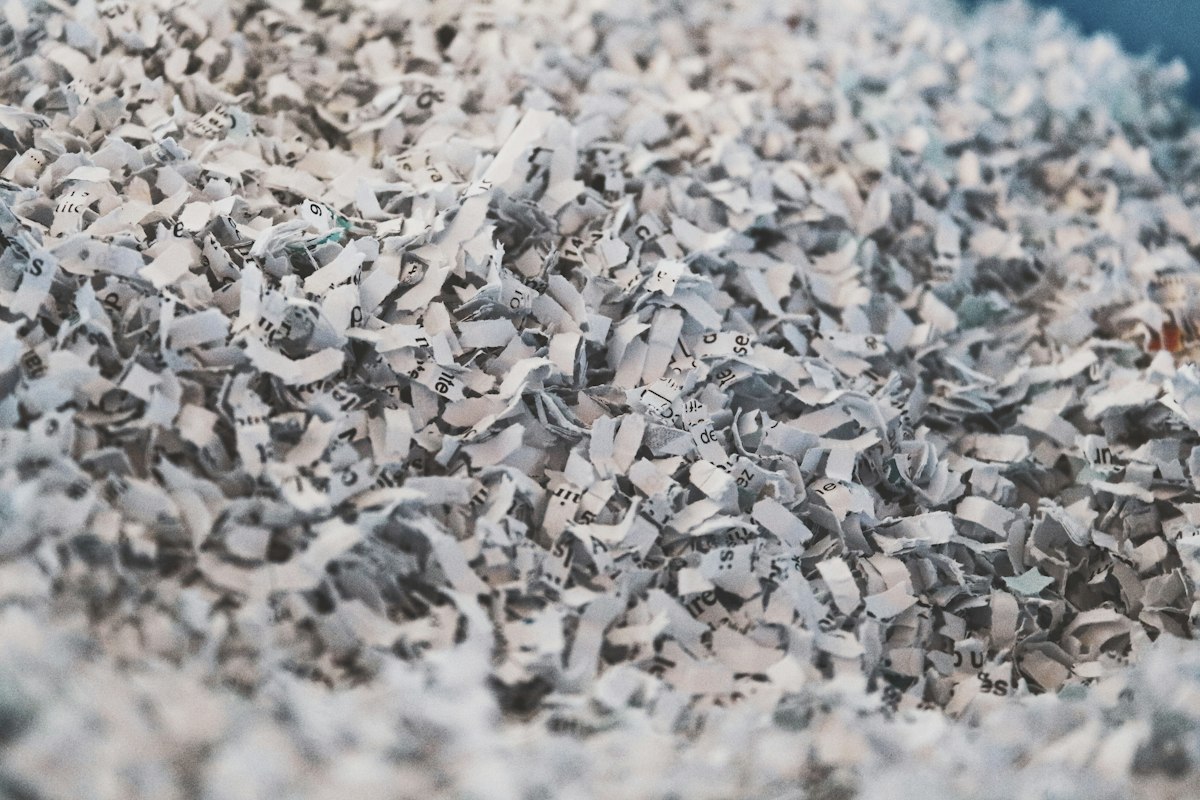
Both cross-cut and micro-cut shredders reduce a page into pieces rather than leaving it as long strips. Micro-cut generally describes smaller particles, but the name alone is not a complete specification. Compare the actual cut dimensions and any stated security classification for the exact model. Similar names on two boxes need not describe identical results.
Begin with the papers, not the shredder
A stack of outdated meeting agendas does not present the same disposal question as financial records or documents containing other people's personal information. Decide what you are responsible for protecting and whether an employer, client or organization has a required destruction process. A household buying guide should not replace such a policy with a casual recommendation based on a marketing label.
Smaller particles can make the original harder to reconstruct, but the entire workflow still matters. Papers waiting beside the machine remain readable. A full bag left in an accessible shared area is still outside your control. Store material awaiting destruction securely and arrange the final disposal as deliberately as the cutting step.
Compare operation alongside the cut
Check sheet capacity, run time, cooling time and accepted materials separately. Do not assume that a finer cut always comes with a particular speed or maintenance schedule. Those are model characteristics. A machine that cannot comfortably handle your normal session may encourage postponing disposal, leaving a growing stack of papers waiting for attention.
There may also be different restrictions for cards, staples and optical discs. Permission to shred paper does not imply permission to shred everything that contains information. Some materials require a separate opening or a different destruction service. Follow the manual, remove unsupported attachments and avoid mixing non-paper waste into a paper recycling stream.
If the amount of sensitive material is large or the records are subject to a formal retention and destruction requirement, ask an appropriate service about its handling process. That can be more suitable than buying a small machine and improvising a disposal routine. Keep any required record of destruction according to the policy that applies to the documents.
For ordinary home-office selection, the useful comparison is specific: what particle size does this machine produce, what material can it accept, and can you use and empty it safely? Answering those questions gives the words cross-cut and micro-cut a practical meaning without treating either one as a blanket guarantee of confidentiality.