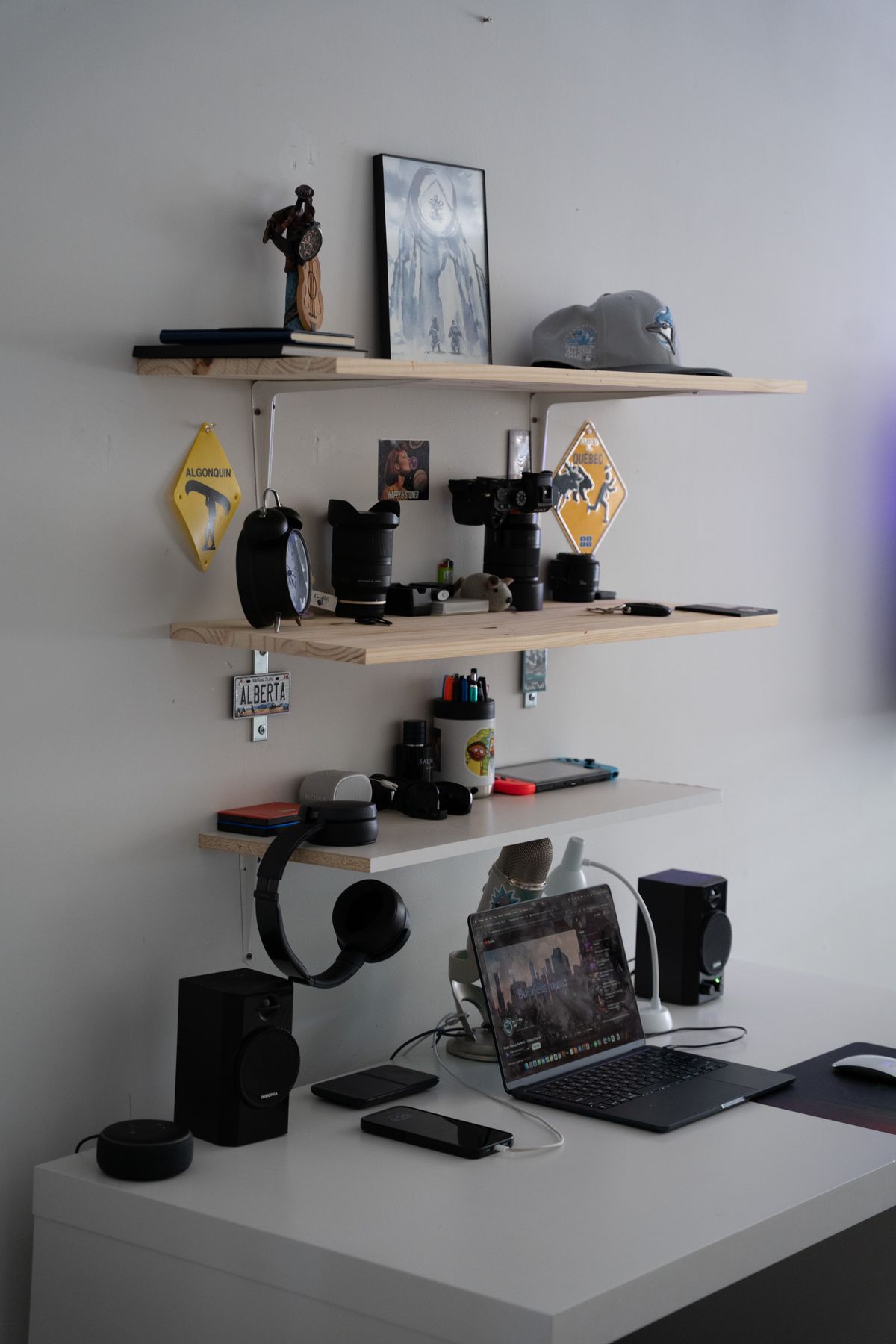
Wall storage can recover working surface, but it also places contents directly in view. A pegboard, shelf or rail becomes cluttered quickly when it is asked to hold everything that no longer fits on the desk. Start with one purpose: active reference material, a few tools or a place for current notes.
Choose objects that benefit from being visible and can be returned easily. A reference card consulted throughout the day may deserve wall space. Spare cables and half-used stationery packets may be better in a drawer, even if a hook can technically hold them.
Set a reachable zone
Sit and stand at the desk to test where items can be reached without leaning over equipment. Keep frequently used objects within a comfortable access area. A high shelf is more suitable for lighter, less-used contents than for a heavy box taken down every morning.
Leave head clearance when standing up or leaning toward the desk. Avoid sharp projections beside a doorway and hooks that put hanging bags into a passage. The wall should remain part of a usable room, not become an obstacle course around the chair.
Match the fixing to the installation
Use a storage system and fastening method appropriate for the wall construction and intended load. The capacity depends on the complete installation, including rails, brackets, fasteners and the wall itself. Do not add several accessory ratings together and assume the mounting can support the sum.
Follow the manufacturer's instructions, and obtain qualified help if the wall construction or concealed services are uncertain. Adhesive hooks have specific surface and load requirements; they are not a substitute for suitable hardware when a shelf requires it.
Leave some wall empty
A small gap between groups makes labels and contents easier to identify. Avoid buying attachments simply because the system has space for them. The useful capacity is the amount you can see and retrieve without disturbing neighboring items.
Review the wall when a project ends. Remove expired notes, return borrowed tools and relocate materials that are no longer active. Private information should not remain visible to visitors or in a camera background.
A good wall arrangement can be described in a sentence: current project notes above the desk, or a few frequently used tools beside it. When its purpose needs a long explanation, the wall may be holding too many unrelated jobs.